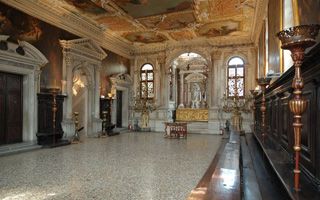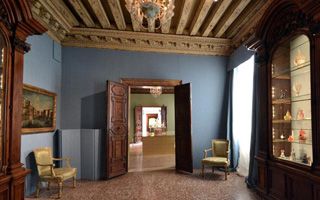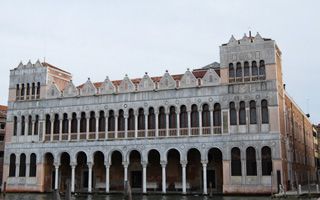
Punta della Dogana
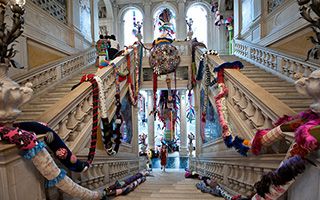
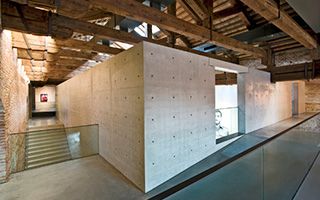
During the fifteenth century, developments in Venice’s commercial activities led to the Sea Customs House, which had previously been near the Arsenal, being transferred to the western point of Dorsoduro. The building as it stands today was completed in 1682, five years before the nearby Basilia of the Salute. Architect Giuiseppe Benoni’s work is characterised by the tower surmounted by a sculptural group representing two Atlases lifting a golden bronze sphere on the top of which is Fortune, which, by turning, indicates the direction of the wind. The building continued to be a customs house, and thus intrinsically linked to the city’s history, until the 1980s. After twenty years of abandonment, the Venice city council announced a tender to transform it into a contemporary art space. The Pinault Collection was awarded the tender in 2007, and entrusted the restoration of the imposing complex to architect Tadao Ando. In June 2009, after 14 months of work, Punta della Dogana reopened to the public with the exhibition "Mapping the Studio".
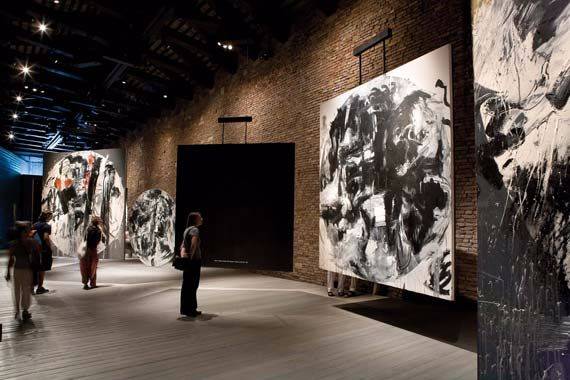
Fondazione Vedova
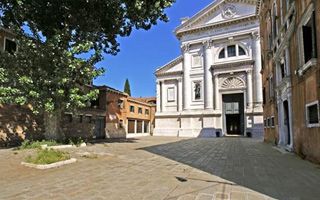
The main aim of the Foundation is to promote art and work of Vedova and highlight his importance in the history of 20th century art through a series of initiatives, such as studies, research projects, analyses, exhibitions, itineraries and educational areas, conferences, scholarships and prizes.
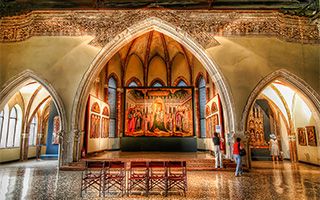
Gallerie dell'Accademia
The Accademia di Belle Arti di Venezia was founded in 1750. The first director was Giovanni Battista Piazzetta; Gianbattista Tiepolo became the first president after his return from Würzburg. It was one of the first institutions to study art restoration starting in 1777 with Pietro Edwards, and formalised by 1819 as a course. In 1807 the academy was re-founded by Napoleonic decree. The name was changed from Veneta Academia di Pittura, Scultura e Architettura to Accademia Reale di Belle Arti, "royal academy of fine arts", and the academy was moved to the Palladian complex of the Scuola della Carità, where the Gallerie dell'Accademia are still housed. The collections of the Accademia were first opened to the public on 10 August 1817. The Gallerie dell’Accademia contains masterpieces of Venetian painting up to the 18th century, generally arranged chronologically though some thematic displays are evident.
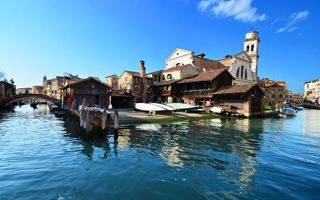
Squero di San Trovaso
A “squero” is an historical gondola and boats workshop, and this name comes from the word “squara”, which indicates the team of artisans involved in the construction of a boat. The squero is surrounded by Tyrolian-looking wooden structures (a true rarity in this stone city built on water, and an oddity shared by most squeri) that are home to the multiple-generational owners and original workshops for the traditional boats.
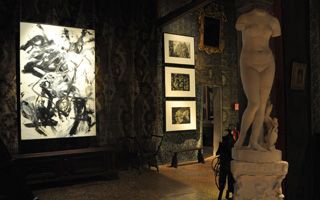
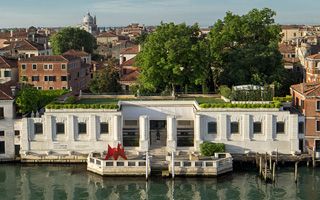
Peggy Guggenheim Collection
In 1949 Peggy Guggenheim (former wife of artist Max Ernst and a niece of the mining magnate, Solomon R. Guggenheim) bought the Palazzo Venier dei Leoni (an 18th unachieved building known as the “Unfinished Palace”) as her personal home. Collector, dealer and patron of arts, since 1951 Peggy Guggenheim opened the doors of her home to expose her outstanding art collection, created mostly between 1938 and 1946. The collection include prominent Italian futurists and American modernists masterpieces, and embrace also Cubism, Surrealism and Abstract expressionism. Nowadays the Peggy Guggenheim Collection is one of the most visited museum of Venice.
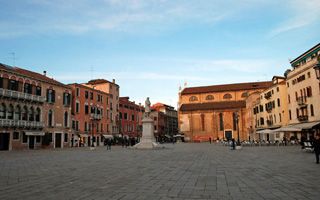
Campo San Barnaba
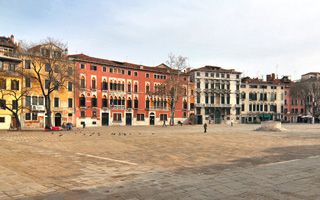
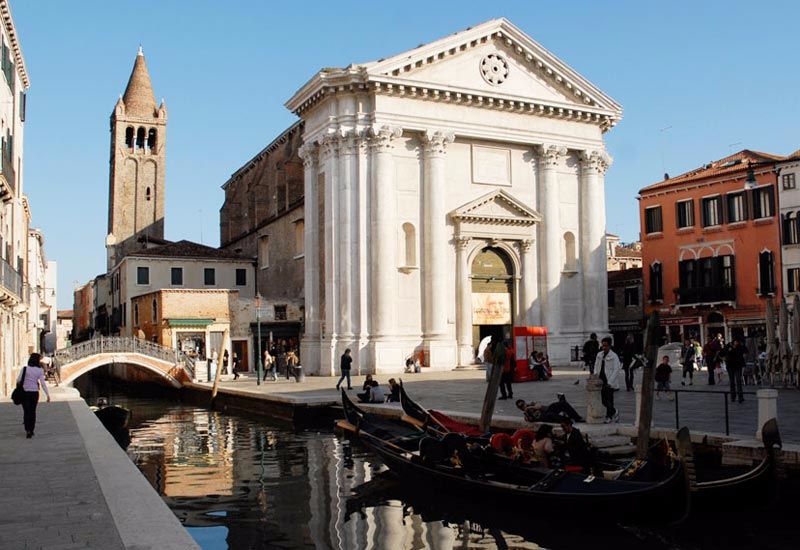
Campo San Barnaba is a quietly appealing campo (square), with wine-bars, a traditional vegetable barge on the canal side, and the neighborhood's church San Barnaba (today hosting an exposition of “Da Vinci’s inventions models”). This campo has been featured in numerous films, including Indiana Jones and the Last Crusade where it served as the exterior to the library. Close to the campo is located one of the several “Ponti dei Pugni” (bridges of fists) of the city, distinguished by two pairs of footprints set in white stone on top of the bridge. These mark the starting positions for the fights between rival factions : formerly there were no balustrades, and contenders hurled each other straight into the water. The battles became so bloodthirsty that they were banned in 1705.
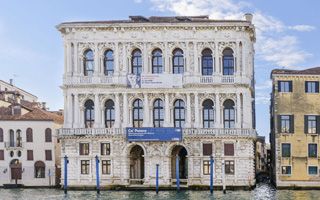
Ca’ Rezzonico
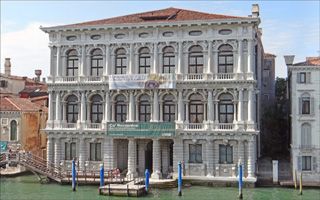
This richly furnished Baroque palace is one of the most splendid in Venice, and also one of the few in the city that opens its doors to the public. Since 1934 it has housed a vast collections of 18th-century Venetian art, including paintings (such as works of Giandomenico Tiepolo, Tintoretto, Cima da Conegliano, Pietro Longhi), collections of antique furniture, and also a fine collection of Venetian glass. Started in 1649 by the family Bon, the original project was conceived by Baldassarre Longhena, one of the most important proponent of Venetian Baroque (a style slowly replacing the Renaissance and Palladian architectural style). The palazzo was not finished until 1756 by the architect Giorgio Massari, who had adhered to the original plans of Longhena, with the addition of some concepts of his own which reflected the change in architecture between the palazzo's conception and its completion 100 years later.
La Fondamenta delle Zattere
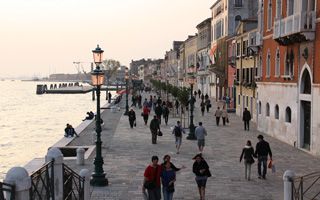
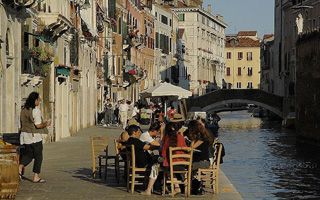
The Fondamenta delle Zattere (in Venice a “fondamenta” is the bank for pedestrians along a canal) is a 1.4 km long quayside looking across to the island of Giudecca. The name derives from the rafts (“zattere” in Italian) made of and carrying timber from the Republic’s forests. Oriented to the south, this fondamenta is one of the Venetian’s favorite places to have a walk on a sunny day, and the perfect place to contemplate a romantic sunset over the lagoon. Several bars, restaurants and ice-cream shops occupy the waterside, offering the possibility of a tasty pause along the way.
Santa Maria della Salute
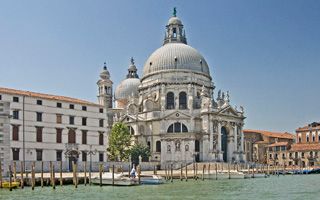
Santa Maria della Salute is a church built between 1631 and 1687 and designed in the fashionable baroque style by Baldassare Longhena. The church was built in thanksgiving for the deliverance of the city from the plague of 1630, hence the name “salute”, meaning health and salvation. Every 21 November, in celebration, worshippers approach across a bridge of boats that span the mouth of the Grand Canal. The church is located on the narrow finger of Punta della Dogana, between the Grand Canal and the Giudecca Canal, making the church visible when entering the Piazza San Marco from the water. The dome of the Salute was an important addition to the Venice skyline and soon became emblematic of the city, inspiring artists like Canaletto, J. M. W. Turner, John Singer Sargent, and Francesco Guardi.
Scuola dei Carmini
The “scuole” were peculiarly Venetian institution. Founded mainly in the 13th century, they were lay confraternities existing for the charitable benefit of the neediest groups of society, the professions or resident ethnic minorities. Built in 1663 as the headquarters of the Carmelite confraternity, the present Scuola building was designed by Francesco Caustello and Baldassare Longhena. In the 1740s Giambattista Tiepolo was commissioned to decorate the ceiling of the hall. In 1807, the confraternity was suppressed by Napoleon's anticlerical decrees. The Austrians allowed the Scuola to reopen, and it continues activities today, though mostly cultural activities.